
The Cross-Pollinator Strategy: How to Scale Meta Ads With an Agent
Most brands scale a winning ad by throwing more budget at it. There's a better way: give Meta more places to find scale, and let an agent do the busywork.

Key takeaways
- Scaling a winning Meta ad isn't about raising its budget. It's about giving Meta more ad sets and landing pages to find scale on the same creative.
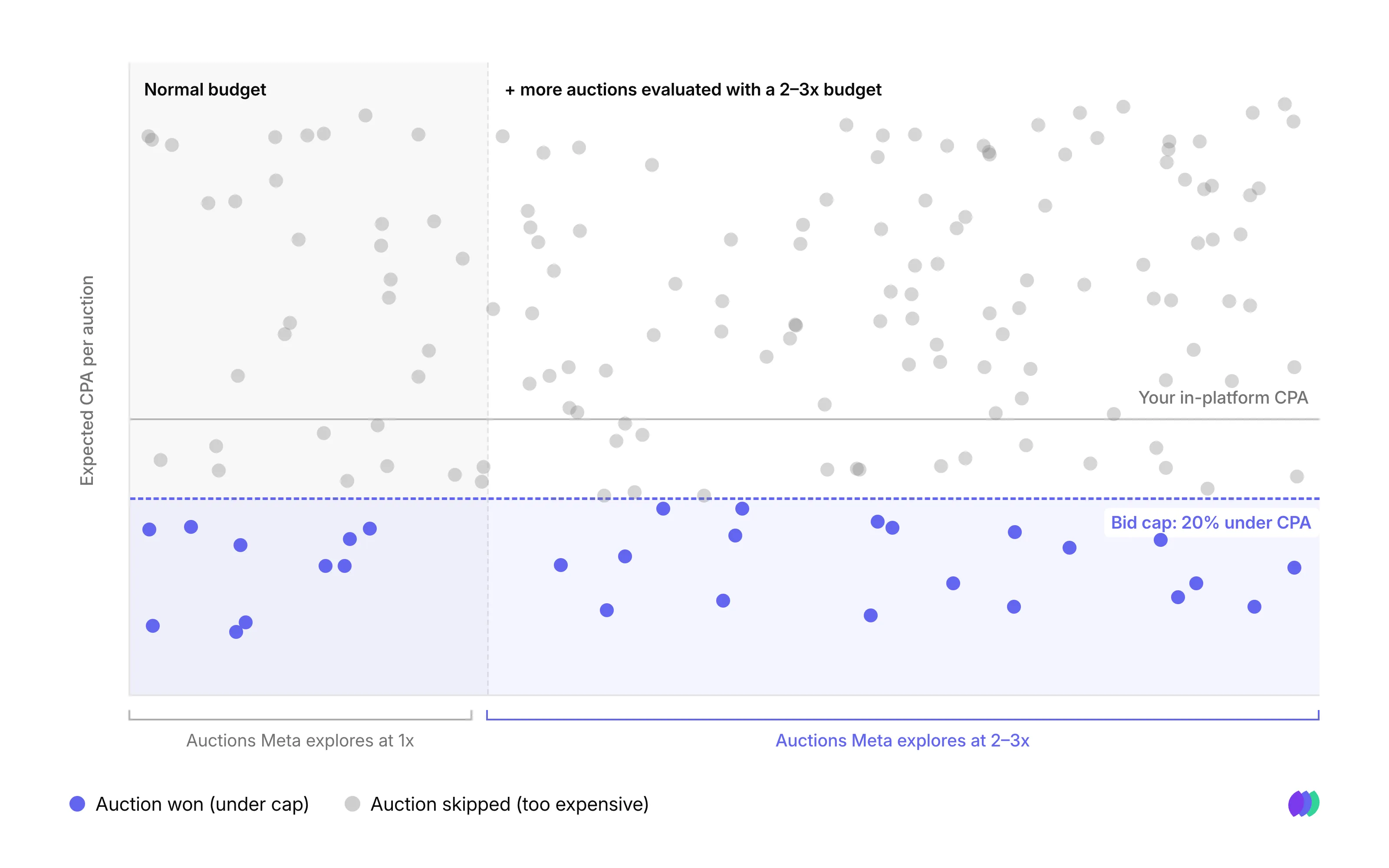
- The Inflated Budget System campaign gives Meta a budget ceiling 2 to 3x your real daily spend, with a manual bid or cost cap set under your CPA target, so it never runs out of room to scale a winner.
- An agent like Hudson can run the entire loop: watching for winners, duplicating them into new ad sets and landing pages, and sending you a weekly plan to approve.
Most people scale a winning Meta ad the obvious way. They find something that works and they push more budget into it. That works for a while, then it stalls out, because you’re asking one ad, in one ad set, to carry all the weight.
The better way is to give Meta more surface area to work with. Same winning ad, but spread across more ad sets and more landing pages, so the algorithm has more places to go look for scale. I call this the Cross-Pollinator strategy, and it’s built specifically to run on an agent, because the whole thing is really just duplicating and monitoring, over and over, forever.
Step 1: Set up an Inflated Budget System campaign
I picked this up years ago from some old Meta disruptor reps, and it still works. The idea is you build one campaign with a budget way bigger than you’d ever actually spend, so Meta never runs out of room when it finds something worth scaling.
Here’s how to set it up:
- Make it a CBO campaign.
- Set the budget at 2 to 3 times your total daily account spend. If your whole account spends $10k a day, set this campaign’s budget at $30k a day. Most accounts I run this on sit anywhere from $50k to $200k a day.
- Use manual bidding, either a cost cap or a bid cap. Set it about 20% below your actual CPA target.
- Launch it low on purpose. You want it to spend close to nothing at first. Then bump the cap up a few dollars at a time.
- If you’re using a cost cap, set it 20% under your current in-platform CPA. If you’re using a bid cap, just set it low, lower than you’d expect it to actually spend.
- Use a 1 day or 7 day click attribution window. No view-through. I normally run 7 day click, 1 day engaged view on most campaigns, but not here. This campaign is bottom of funnel only, and if you let view-through attribution in, it’ll flood Meta with soft signal and make it want to scale too fast on the wrong thing.
Step 2: Split it into ad sets by landing page
Inside that campaign, build 2 to 3 ad sets:
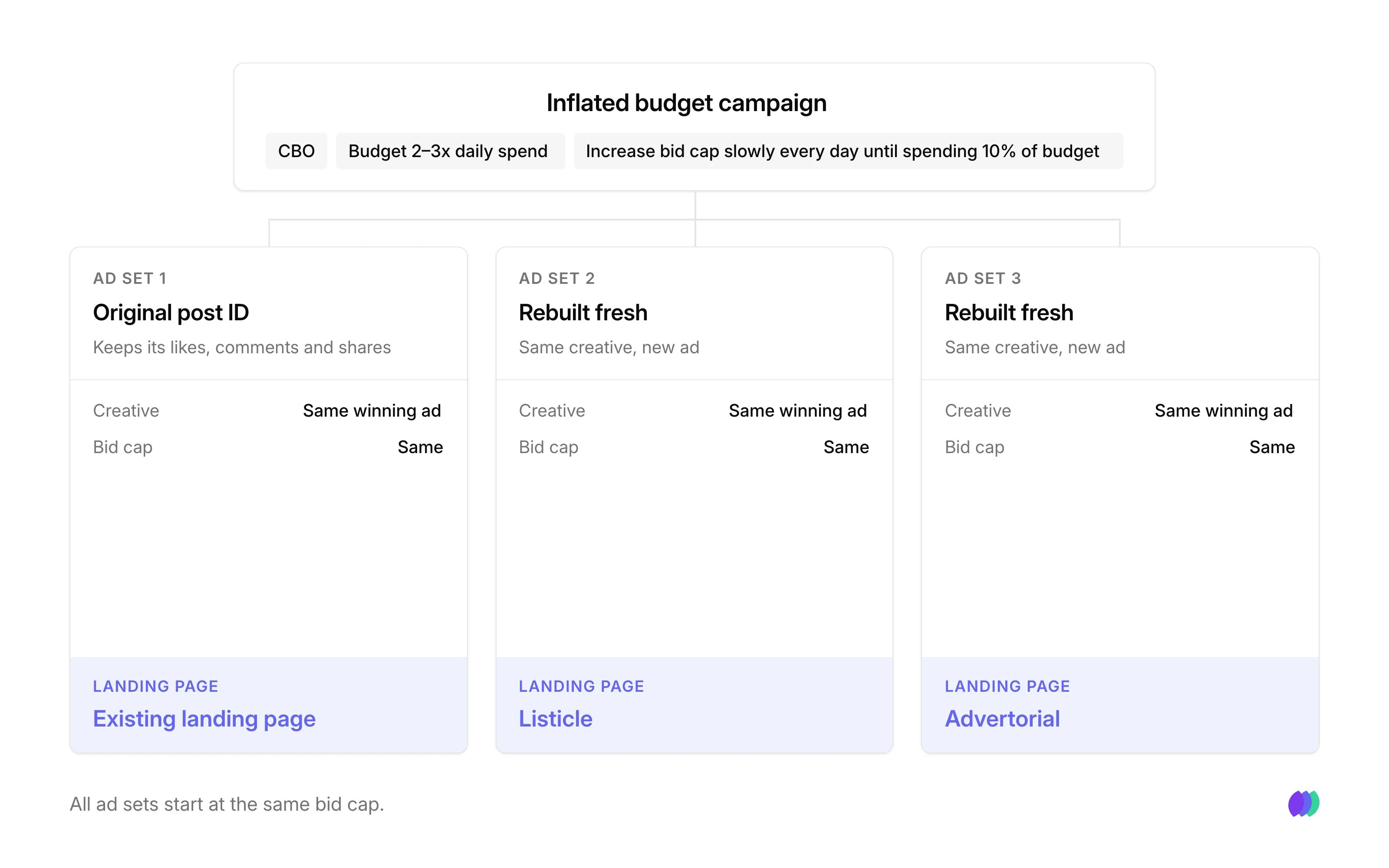
- One ad set runs your winning ads by their original post ID, so they keep all the social proof, comments, and likes they’ve already built up.
- The other ad set(s) run the exact same winning creative, rebuilt fresh, pointed at a different landing page. Most brands already have a couple of pages that convert well outside the standard PDP or offer page: a listicle, an advertorial, whatever’s working. Use those.
Start all of them at the same bid cap. The only thing different between ad sets is the landing page. Everything else about the ad stays the same.
Step 3: Let Hudson run it as a loop
This is the part that makes it actually sustainable. You set Hudson up with a recurring loop that does the cross-pollinating for you:
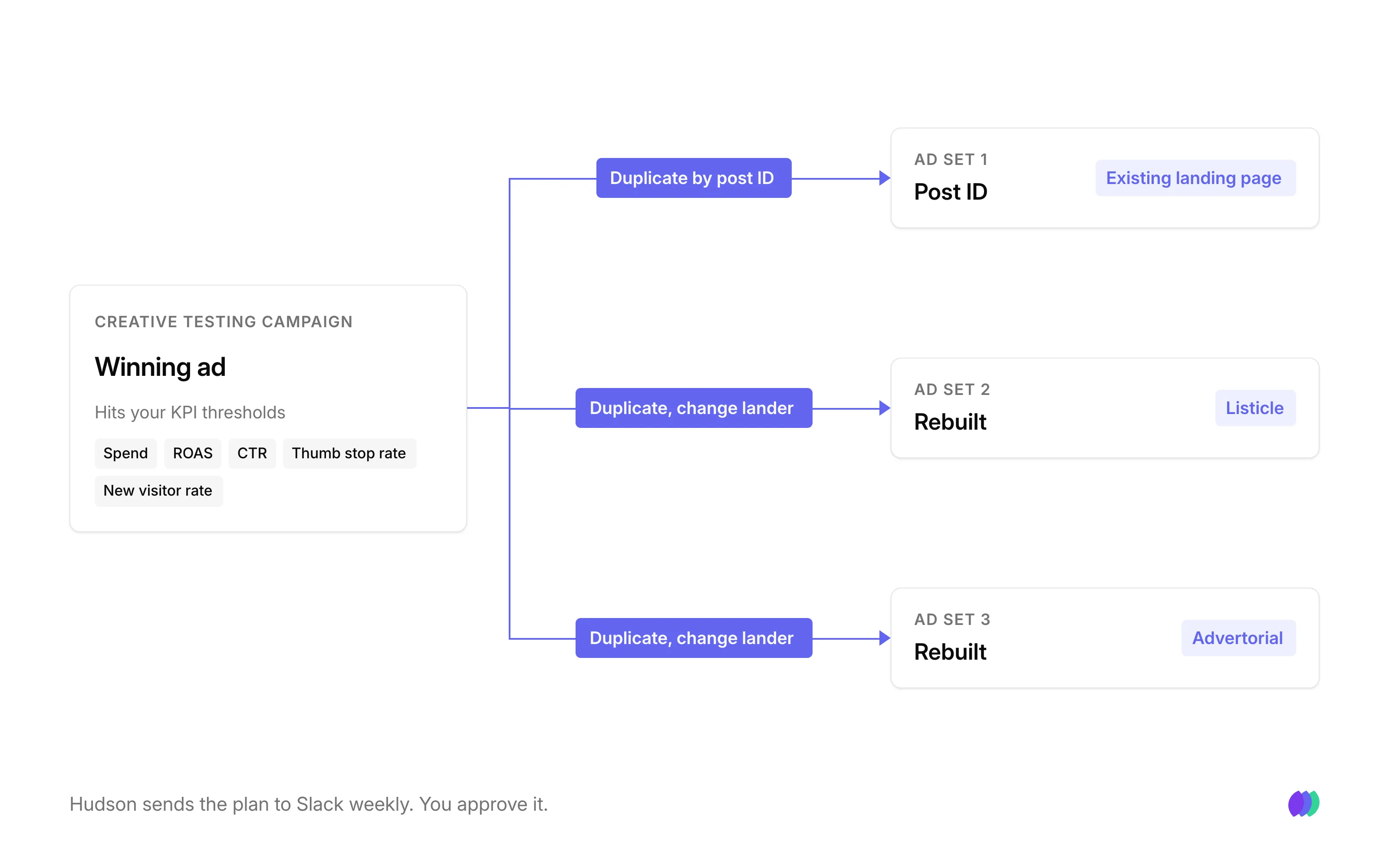
- It watches your creative testing campaign for ads that hit your KPI thresholds: spend, ROAS, CTR, thumb stop rate, new visitor rate, whatever you use to call something a winner.
- Once an ad qualifies, Hudson duplicates it by post ID into the winning post ID ad set, and rebuilds it into the other ad sets with the different landing pages.
- Nothing about the ad changes except the landing page.
- Once a week, you get a Slack notification with the plan. You open it up, look at what Hudson wants to duplicate, and approve it.
This is just one of a handful of tactics you can run Hudson on to get more efficient, more effective spend out of Meta. Using an agent for media buying isn’t just about cutting busywork, it’s about moving the metrics that actually matter: CAC, MER, contribution margin.
If you think the Cross-Pollinator strategy, or tactics like it, could work for your account, book a demo below. We’d love to talk.